What is career readiness?
Career readiness is a foundation of core skills that prepare students for success in the workplace. Each day you are building career readiness – in class, through activities, at internships and campus jobs, and while volunteering in the community. Use career readiness as a guide to understand what employers are looking for in applicants.
Skills employers value
Employers look for three types of skills: career readiness skills, transferable skills, and industry-specific skills. Career readiness skills are the foundation for workplace success. Transferable skills are broad abilities that can be used across many experiences and environments. Industry skills are specialized capabilities and knowledge required for a particular career field or profession.
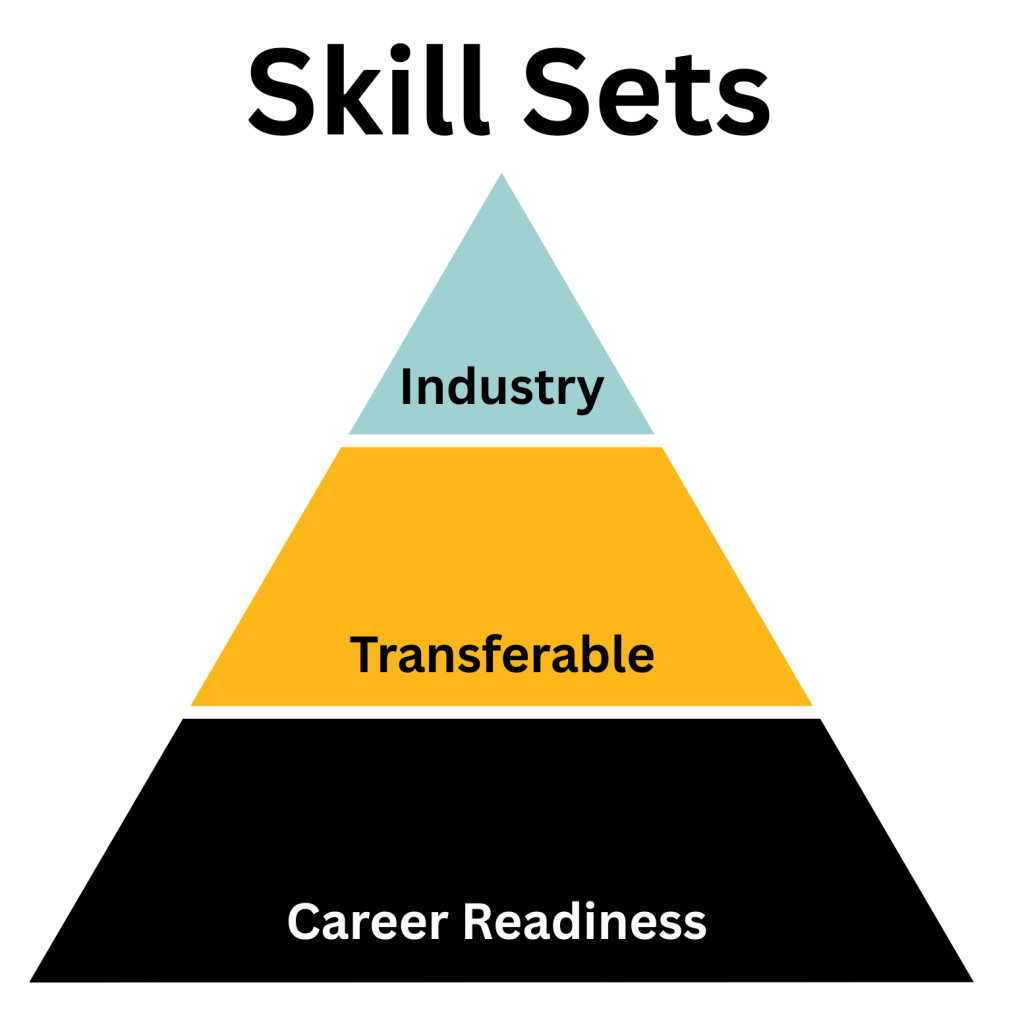
The good news is that the Missouri Method’s hands-on, learning-by-doing approach helps prepare you for a successful career. Through coursework and co-curricular experiences, you are developing many of the skills that employers seek.
The Career Center can help you identify key skills you need to attain and communicate the skills you possess so employers see how you can contribute to their workforce.
Career ready & transferable skills
Expand the sections below to learn about career readiness and how transferable skills connect to one another. Developing these skills throughout your time at Mizzou can help you succeed in internships, jobs, and future career opportunities. The Career Center can help you identify skills, highlight your strengths, and communicate your abilities effectively in resumes, interviews, and your online presence.
Proactively develop oneself and one’s career through continual personal and professional learning, awareness of one’s strengths and weaknesses, navigation of career opportunities, and networking to build relationships within and without one’s organization.
What it looks like:
- Voluntarily participate in further education, training, or other events to support one’s career.
- Show an awareness of own strengths and areas for development.
- Identify areas for continual growth while pursuing and applying feedback.
- Develop plans and goals for one’s future career.
- Professionally advocate for oneself and others.
- Display curiosity; seek out opportunities to learn.
- Assume duties or positions that will help one progress professionally.
- Establish, maintain, and/or leverage relationships with people who can help one professionally.
- Seek and embrace development opportunities.
Transferable Skills:
- Adaptability, curiosity, goal-setting, motivation, resilience, self-awareness
Clearly and effectively exchange information, ideas, facts, and perspectives with persons inside and outside of an organization.
What it looks like:
- Understand the importance of and demonstrate verbal, written, and non-verbal/body language, abilities.
- Employ active listening, persuasion, and influencing skills.
- Communicate in a clear and organized manner so that others can effectively understand.
- Frame communication with respect to diversity of learning styles, varied individual communication abilities, and cultural differences.
- Ask appropriate questions for specific information from supervisors, specialists, and others.
- Promptly inform relevant others when needing guidance with assigned tasks.
Transferable Skills:
- Active listening, Editing, Information synthesis, Persuasion, Presentation skills, Public speaking, Storytelling, Writing)
Identify and respond to needs based upon an understanding of situational context and logical analysis of relevant information.
What it looks like:
- Make decisions and solve problems using sound, inclusive reasoning and judgment.
- Gather and analyze information from a diverse set of sources and individuals to fully understand a problem.
- Proactively anticipate needs and prioritize action steps.
- Accurately summarize and interpret data with an awareness of personal biases that may impact outcomes.
- Effectively communicate actions and rationale, recognizing the diverse perspectives and lived experiences of stakeholders.
- Multi-task well in a fast-paced environment.
Transferable Skills:
- Data analysis, Evaluation, Innovation, Logical reasoning, Problem-solving
Recognize and capitalize on personal and team strengths to achieve organizational goals.
What it looks like:
- Inspire, persuade, and motivate self and others under a shared vision.
- Seek out and leverage diverse resources and feedback from others to inform direction.
- Use innovative thinking to go beyond traditional methods.
- Serve as a role model to others by approaching tasks with confidence and a positive attitude.
- Motivate and inspire others by encouraging them and by building mutual trust.
- Plan, initiate, manage, complete, and evaluate projects.
Transferable Skills:
- Coaching, Conflict resolution, Decsion-making, Delegation, Mentorship, Strategic planning
Knowing work environments differ greatly, understand and demonstrate effective work habits, and act in the interest of the larger community and workplace.
What it looks like:
- Act equitably with integrity and accountability to self, others, and the organization.
- Maintain a positive personal brand in alignment with organization and personal career values.
- Be present and prepared.
- Demonstrate dependability (e.g., report consistently for work or meetings).
- Prioritize and complete tasks to accomplish organizational goals.
- Consistently meet or exceed goals and expectations.
- Have an attention to detail, resulting in few if any errors in their work.
- Show a high level of dedication toward doing a good job.
Transferable Skills:
- Accountability, Attention to detail, Dependability, Integrity, Time management, Work ethic
Demonstrate the awareness, attitude, knowledge, and skills required to engage and include people with different perspectives and experiences.
What it looks like:
- Solicit and use feedback from multiple perspectives to make well-informed decisions.
- Actively contribute to developing practices that thoughtfully support the needs of others and engage in building a positive workplace community.
- Identify and eliminate discrimination.
- Seek new interactions and experiences that enhance one’s understanding of others and that lead to personal growth.
- Be open to learning from others by demonstrating curiosity and humility about different ideas and new ways of thinking.
- Demonstrate flexibility by adapting to various environments.
- Examine your own perspectives and decision-making processes to deepen your own self-awareness.
Transferable Skills:
- Emotional intelligence, Empathy, Flexibility, Inclusion, Open-mindedness, Social awareness
*Adapted with permission from the original NACE definition and behaviors.
Build and maintain collaborative relationships to work effectively toward common goals, while appreciating diverse viewpoints and shared responsibilities.
What it looks like:
- Listen carefully to others, taking time to understand and ask appropriate questions without interrupting.
- Effectively manage conflict, interact with and respect diverse personalities, and meet ambiguity with resilience.
- Be accountable for individual and team responsibilities and deliverables.
- Employ personal strengths, knowledge, and talents to complement those of others.
- Exercise the ability to compromise and be agile.
- Collaborate with others to achieve common goals.
- Build strong, positive working relationships with supervisor and team members/coworkers.
Transferable Skills:
- Collaboration, Cross-functional work, Relationship management, Trust building
Resume Action Verbs:
- Advised, Contributed, Integrated, Mediated, Partnered, Resolved, Shared, Supported, Unified, etc.
Understand and leverage technologies ethically to enhance efficiencies, complete tasks, and accomplish goals.
What it looks like:
- Navigate change and be open to learning new technologies.
- Use technology to improve efficiency and productivity of their work.
- Identify appropriate technology for completing specific tasks.
- Manage technology to integrate information to support relevant, effective, and timely decision-making.
- Quickly adapt to new or unfamiliar technologies.
- Manipulate information, construct ideas, and use technology to achieve strategic goals.
Transferable Skills:
- AI and big data, Digital tools, Cloud computing, Information security, Software literacy, Technical troubleshooting, etc.
Resume Action Verbs:
- Assembled, Built, Diagnosed, Extracted, Installed, Operated, Processed, Programmed, Visualized, etc.
*Career Readiness was developed by the National Association of Colleges and Employers (NACE). The Career Center adapted the original competency with NACE’s permission.